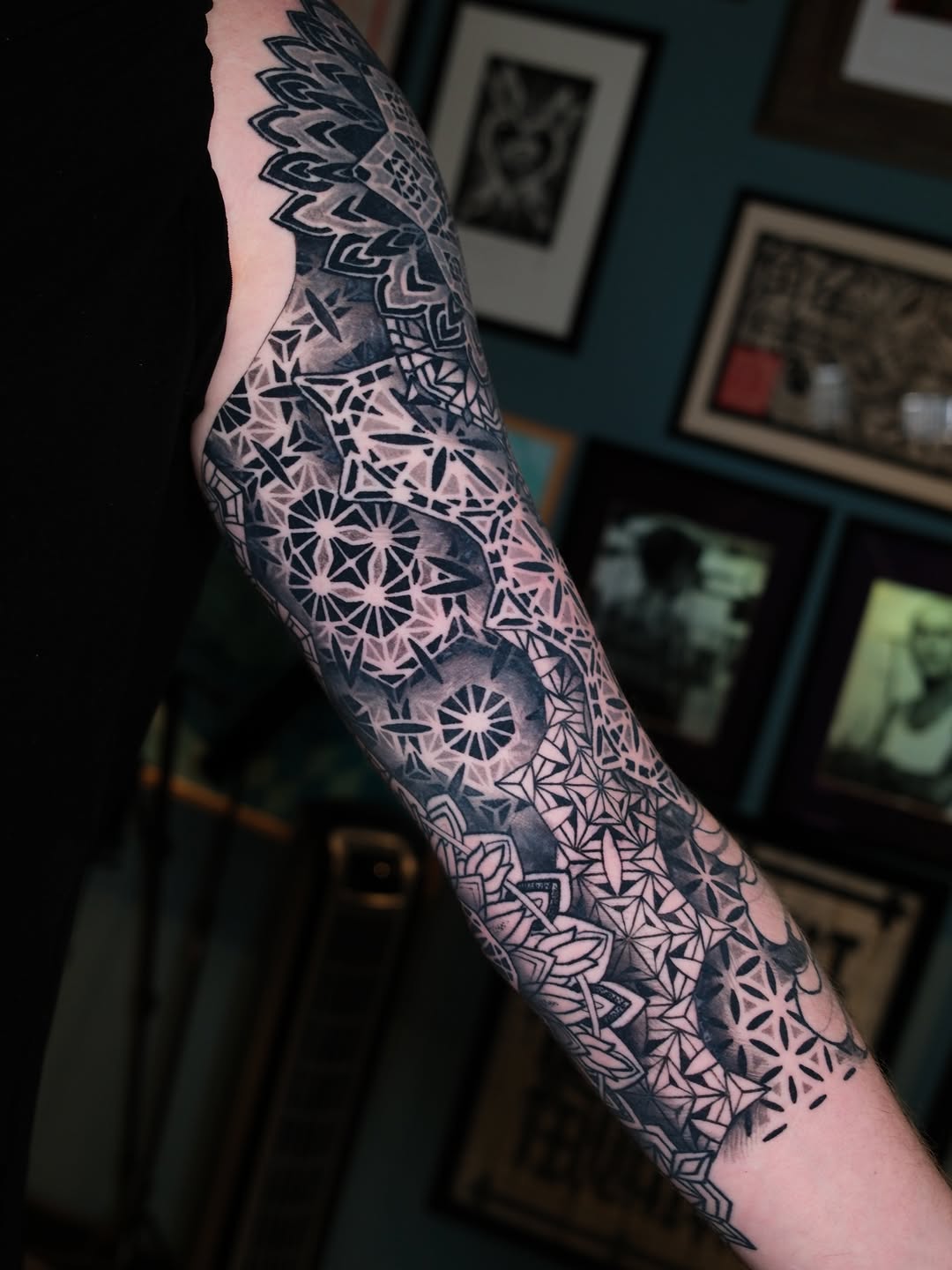
Every tattoo style has its own demands. Realism requires an eye for shadow and depth. Traditional needs bold confidence and solid fills. Watercolor lives in controlled chaos. But geometric tattooing is different from all of them — and not just aesthetically. The difference is structural. It shows up in how the work is designed, how it's executed, and ultimately, whether it holds up.
There's nowhere to hide
In most tattoo styles, imperfection can be absorbed. A slightly uneven line gets lost in shading. A wobbly edge disappears into a blur. The eye is guided by value, color, and contrast — and small mistakes get swallowed by the complexity of the piece.
Geometric work has none of that forgiveness. A line is either straight or it isn't. A circle either closes perfectly or it doesn't. Symmetry either holds across the entire piece or the whole thing falls apart. You cannot hide a mistake in a mandala the way you can hide one in a portrait. The geometry exposes everything.
This is why the bar is so high. It's also why the best geometric artists tend to be obsessive about precision in a way that stands apart from other styles.
The design comes before the needle
Most geometric pieces are fully solved on paper — or screen — before a machine ever touches skin. You're working out a geometry problem first. How do these shapes interlock? Does this ratio hold at this scale? Where does the pattern terminate at the edge of the body part, and does that termination feel intentional or accidental?
That design phase is its own discipline. Some of the best geometric tattoo artists are as much architects as they are tattooers. The drawing isn't just a sketch — it's structural documentation. Get it wrong in the planning and you'll spend hours tattooing something that doesn't work.
The body isn't flat
This is the part that separates good geometric from great geometric. Flat geometry applied to a curved, living surface without accounting for that surface will look wrong. A circle drawn as a circle on a bicep becomes an oval when the arm flexes. A grid that looks perfectly proportioned on a flat piece of paper will appear to compress and stretch when wrapped around a ribcage.
The artists who do this at the highest level aren't just applying patterns — they're compensating for the body's three-dimensional form in real time, adjusting proportions and angles to make the work look correct on a surface that was never designed to hold geometry. That spatial intelligence is hard-won and can't be faked.
It ages by the lines
All tattoos age. Ink spreads, skin changes, pigment fades. But geometric work lives or dies by the integrity of its lines in a way other styles don't. A portrait with slightly softened lines still reads as a portrait. A geometric piece with blowouts or spread lines loses its core logic — the precision that made it work in the first place.
This makes placement and technique non-negotiable. Depth matters. Needle choice matters. Skin health matters. A geometric tattoo done right by someone who understands the long game will still be sharp ten years out. Done wrong, it's unreadable in five.
The community is small on purpose
There aren't that many people doing geometric tattooing at the level where all of this comes together. The style demands too much — the mathematical thinking, the technical execution, the spatial awareness, the patience. You can't shortcut your way into being good at it.
That's what @omfgeometry is about. Not every tattoo account. Not every style. Just this one — the artists who took geometry seriously enough to master it, and the work they're producing right now, all over the world.
Browse the Artist Directory to find them. Follow @omfgeometry to see the work as it gets made.