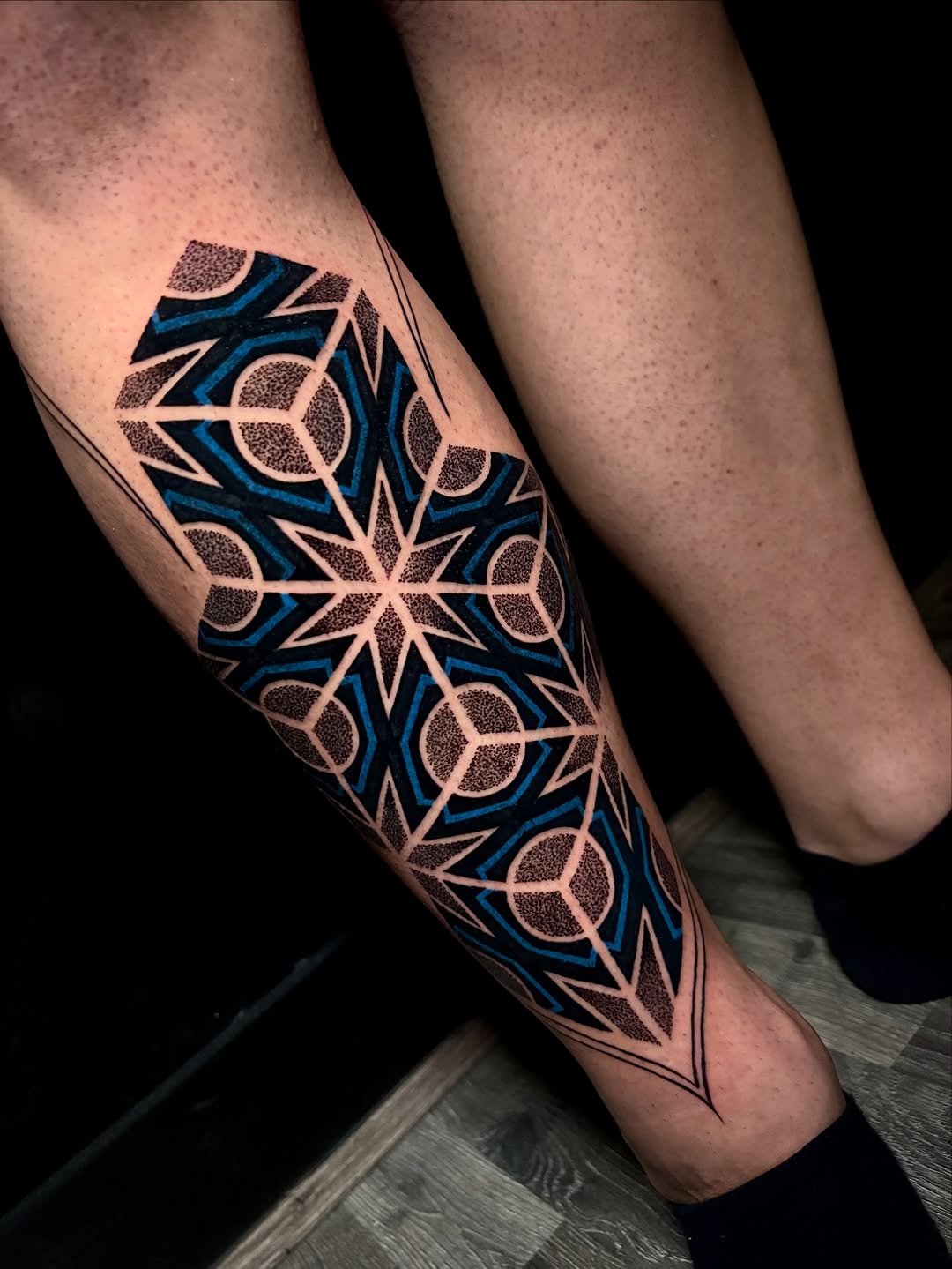
Some artists find a style. Alex Santucci built a language. The Italian-based tattooist known as @alex_santucci_tattooer has developed one of the most architecturally rigorous approaches in geometric tattooing — work that reads less like decoration and more like structural drawing done directly on skin.
The architecture of the work
What separates Santucci's pieces from generic geometric tattooing is a commitment to internal logic. Every element in his compositions has a reason to be exactly where it is. Lines don't just converge — they resolve. Forms don't just repeat — they evolve. Looking at a finished piece, you can trace the underlying geometry back to its source, like reading a proof.
This is harder than it sounds. Many geometric tattoos are visually complex without being structurally sound — they create the impression of precision without the underlying mathematics to back it up. Santucci's work doesn't have that problem. The structure is always there, and it's always honest.
Sacred geometry as source material
The vocabulary Santucci draws on is ancient. Metatron's Cube. The Flower of Life. Platonic solids. These aren't decorative choices — they're load-bearing structures. Sacred geometry carries centuries of accumulated visual and mathematical meaning, and the artists who use it well understand that the power isn't in the symbol itself. It's in what happens when you build something correctly proportioned from it and put it on a living body.
Santucci treats these forms the way a trained architect treats classical orders: as a starting point, not an end point. He uses them to establish the skeleton, then builds outward with his own extensions — thin-line details, precision dotwork, negative space that earns its emptiness. The result feels both universal and entirely personal.
The technical floor
None of this works without an exceptionally high technical floor. Geometric tattooing at this scale — Santucci regularly executes large chest and back pieces — requires consistent line weight across hours of work, the ability to hold freehand curves that read as mathematically clean, and the discipline to stop before overworking. Adding one unnecessary line to a piece like this doesn't just add noise. It breaks the logic.
His linework is tight enough to be impressive up close and structured enough to read clearly at distance. That double-requirement — micro-precision and macro-coherence — is one of the hardest things to achieve in the style. Most artists optimize for one or the other. Santucci consistently does both.
Why this work matters to the page
@omfgeometry has been following Alex Santucci's output for years. His work represents exactly what the page exists to highlight: artists who have taken geometric tattooing seriously enough to develop a genuine point of view, and who execute at a level that raises the standard for everyone working in the style.
If you look at the work and immediately want to understand how it was made — if you want to trace the lines back to their origin — that's the signal. That's an artist doing something worth paying attention to.
Follow @alex_santucci_tattooer on Instagram. His profile is a masterclass in what happens when technical precision and genuine vision occupy the same artist.
And if you're looking for more artists working at this level, the OMF Geometry Directory is the place to start.